The Five Steps
Buy. A property priced below what it will be worth after repairs, usually because it is dated, damaged, or hard to finance in its current condition. Acquisition money is often short-term: cash, a hard money loan, private money, or a line of credit, because many conventional lenders will not lend on a property in poor condition.
Rehab. The renovation that creates the gap between what was paid and what the property is worth finished. The target is the finished value the neighborhood's comparable sales support, not the nicest possible version of the building.
Rent. A tenant in place with a signed lease. Beyond producing income, the lease is evidence. A refinance lender underwriting the rental will look at the rent, and a DSCR lender qualifies the loan on it.
Refinance. A new long-term loan sized as a percentage of the appraised after-repair value (ARV), not of the purchase price. It pays off the acquisition financing, and whatever exceeds that comes back as cash.
Repeat. The returned cash becomes the down payment and rehab budget on the next property. Whatever did not come back is still sitting in the first one.
The Formula
All-in cost      = Purchase + Rehab + Carrying costs
Refinance loan   = ARV × Loan-to-value
Cash left in     = All-in cost − Refinance loan (not below zero)
Share recovered  = Refinance loan ÷ All-in cost
Carrying costs are everything the property costs between purchase and refinance: loan interest, taxes, insurance, utilities. They are easy to leave out because none of them appear on a rehab bid.
How the purchase was financed does not change the result. If a hard money loan funded the purchase, the refinance pays it off first, and the cash still in the deal is the all-in cost minus the new loan either way. Short-term financing changes how much cash is needed up front and how much the carrying costs run, not the arithmetic at the refinance.
A Worked Deal
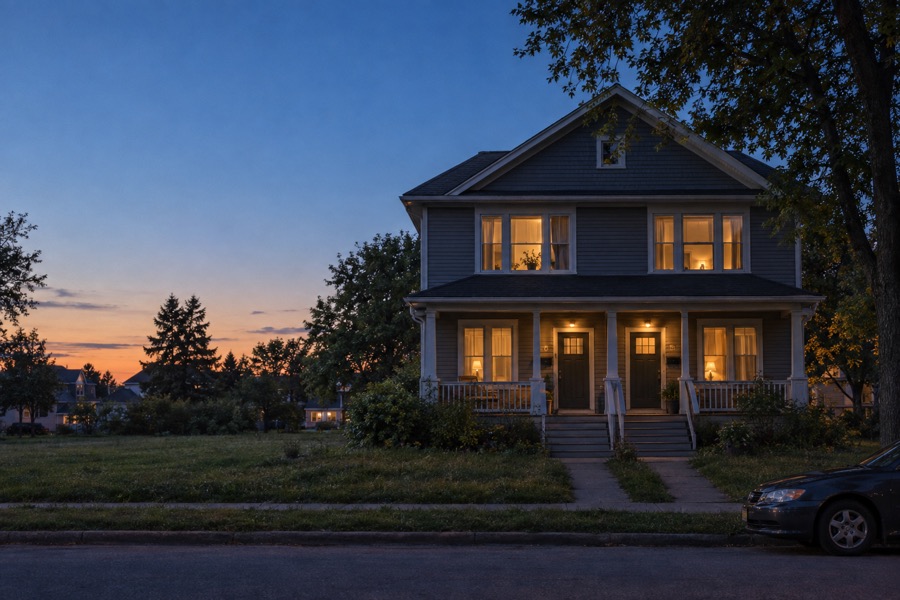
This is the example the BRRRR calculator opens with. The finished property is the same $425,000 duplex I use across this site, so its income numbers agree with every other guide.
All-in cost    = $300,000 + $60,000 + $10,000 = $370,000
Refinance loan = $425,000 × 75% = $318,750
Cash left in   = $370,000 − $318,750 = $51,250
Recovered      = $318,750 ÷ $370,000 = 86.1%
The refinance returns 86.1% of the money. The other $51,250 stays in the property until it is sold or refinanced again. That is a reasonable deal, and it is still $51,250 that is not funding the next one.
The 75% LTV is a common cap on cash-out refinances rather than a fixed rule. The lender and the loan program set it, and a lower cap shrinks the loan dollar for dollar against ARV.
The Trap: ARV Is Set After the Money Is Spent
Every input above is known in advance except one. The purchase price is on the contract, the rehab has bids, the carrying costs can be estimated. The ARV is set by an appraiser after the rehab is finished, which means after all $370,000 is committed.
Run the same deal with the appraisal 10% under the estimate:
ARV            = $425,000 × 90% = $382,500
Refinance loan = $382,500 × 75% = $286,875
Cash left in   = $370,000 − $286,875 = $83,125
The loan shrinks by $31,875, and all of it stays in the deal. A 10% appraisal miss turns $51,250 of trapped capital into $83,125, a 62% increase, because LTV multiplies the error straight into the loan while the all-in cost does not move at all.
Rehab overruns land in the same place. Every dollar over the budget is a dollar added to cash left in, and overruns tend to surface during the same window when the ARV is still unconfirmed. A deal that runs 10% over on rehab and appraises 10% low takes both hits at once.
The 70% Rule, and What It Is Actually Checking
The common screen is that all-in cost should not exceed about 70% of ARV. On a $425,000 ARV:
70% × $425,000 = $297,500 maximum all-in
75% × $425,000 = $318,750 refinance loan
At $297,500 all in, the refinance returns every dollar plus $21,250. The rule works because it leaves a five-point cushion between the all-in cost and the loan, and that cushion is what absorbs a modestly low appraisal or a modest overrun. The worked deal above sits at $370,000, or 87% of ARV, which is why cash stays in.
The rule is a filter for which deals deserve full underwriting, not a result. It assumes a 75% LTV that a given lender may not offer, and it says nothing about whether the property can carry the loan.
After the Refinance: Can the Rent Carry the New Loan?
The refinance loan is sized to the ARV, which makes it larger than a conventional purchase loan would be on a property bought for less. That loan has to be paid from rent.
The finished duplex rents for $3,800 a month and, after 5% vacancy and $17,100 of operating expenses, produces $26,220 of NOI. The $318,750 refinance at 7% over 30 years costs $2,120.65 a month, or $25,448 a year.
DSCR      = $26,220 ÷ $25,448 = 1.03
Cash flow = $26,220 − $25,448 = $772 a year
The property covers its new loan with $772 a year to spare. Against the $51,250 left in the deal, that is a cash-on-cash return of 1.5%. The refinance recovered most of the capital and left a property that barely covers its debt, which is the normal shape of a BRRRR when the loan rate sits above the cap rate. At 7% debt against a 6.2% cap rate, every extra dollar pulled out lowers cash flow. The full ratio is covered in the DSCR formula guide.
The low-appraisal case flips the trade. The smaller $286,875 loan costs $22,903 a year, DSCR rises to 1.14, and cash flow rises to $3,317. More cash is stuck, but the property is safer to hold. Maximum cash out and comfortable coverage pull against each other on the same transaction, and a DSCR lender with a coverage floor above 1.03 may cap the loan before the LTV limit does.
Note what does not move DSCR here: the purchase price. The refinance loan depends on ARV and LTV, so a deal bought at $297,500 all in carries exactly the same $318,750 loan and the same 1.03 coverage. Buying cheaper returns more cash. It does not make the finished rental cash flow better.
"Infinite Returns" Is a Division by Zero
When the refinance returns everything, cash left in is zero, and cash-on-cash return is cash flow divided by zero. That is where the phrase "infinite return" comes from. It describes a formula breaking, not a return.
The capital did not disappear. It was replaced by debt. On the 70%-rule version of the deal, the owner has none of their own cash in, a $318,750 loan, and $772 a year of cash flow before any capital expense. A single capital repair can erase several years of that margin. The deal can be very good, because the owner's equity was created by the rehab rather than paid in, but the risk has moved from the owner's cash to the loan's coverage, and the metric that sounds best is the one that stopped measuring anything.
Seasoning and Timing
Many lenders will only refinance against a new appraised value after the owner has held the property for some period; before that, they lend against the purchase price. That holding period is called seasoning, and it varies by lender and program. On a BRRRR it matters in two ways. It sets how long the capital is tied up before the repeat step can happen, and every month of it is another month of carrying costs added to the all-in number.
A DSCR loan is a common refinance route because it qualifies the property on its own rent rather than the owner's personal income. How those loans are underwritten is in DSCR Loans Explained.
What the Repeat Step Actually Recycles
The repeat step is often described as using the same money over and over. In the worked deal, $318,750 comes back against $370,000 spent, so 13.9% of the capital stays behind. If every deal recovers 86.1%, every cycle leaves 13.9% of its cost in the property it just finished. The portfolio grows, but the pool of recyclable cash shrinks with every deal that does not fully refinance out, unless new savings replace it.
That is why the refinance number deserves the most scrutiny of any number in the deal. Everything else determines whether this property is a good rental. The refinance determines whether there is a next property.
FAQ
How does the BRRRR refinance work?
The lender appraises the finished property and lends a percentage of that after-repair value, commonly up to about 75% on a cash-out refinance, with the exact cap set by the lender. The new loan pays off the acquisition financing and returns the difference as cash.
How much cash stays in a BRRRR deal?
All-in cost minus the refinance loan. On $370,000 all in and a $318,750 loan, $51,250 stays in, and 86.1% of the capital comes back.
What happens if the appraisal comes in low?
The loan shrinks by the appraisal gap times the LTV. A 10% miss on a $425,000 ARV cuts a 75% loan by $31,875, and that amount stays in the property. On the worked deal, cash left in rises from $51,250 to $83,125.
What is the 70% rule?
A screen that caps all-in cost at about 70% of ARV so a 75% LTV refinance returns the full investment with a cushion. On a $425,000 ARV, that is $297,500 all in against a $318,750 loan.
Does BRRRR still work with higher interest rates?
The refinance is where rates bite. The larger the cash-out loan, the harder it is to cover at the new rate. On the finished duplex, a $318,750 loan at 7% leaves a DSCR of 1.03. When the loan rate exceeds the cap rate, pulling maximum cash out and keeping healthy coverage stop being achievable together.
Can I do BRRRR with a hard money loan?
Yes, and it does not change the cash left in at the refinance. The new loan pays off the hard money first. What it changes is the carrying cost, because short-term loan interest and points go into the all-in number.
Related Reading
- DSCR Formula: whether the rent covers the refinance loan
- DSCR Loans Explained: the loan type most BRRRR refinances use
- Cash-on-Cash Return Guide: the return on the cash still in the deal, and why it breaks at zero
- 1031 Exchange Guide: deferring the gain when a BRRRR property is eventually sold
Keep reading
- 1031 Exchange Rules: Timelines, Like-Kind Property and What Gets DeferredHow a 1031 exchange defers capital gains on a property sale: the like-kind and equal-value rules, the 45 and 180 day deadlines, and where exchanges fail.
- Break-Even Occupancy: How Empty a Rental Can Get Before It Loses MoneyThe break-even occupancy and break-even rent formulas for a rental property, worked with real numbers, and what the result says about risk and financing.
- Cap Rate vs Cash-on-Cash Return: When to Use Each MetricCap rate describes the building and ignores the loan. Cash-on-cash describes your cash after the loan. The formulas, the differences, and when each one answers the question.