Net Operating Income: What the Building Earns
NOI = Gross Rent − Vacancy − Operating Expenses
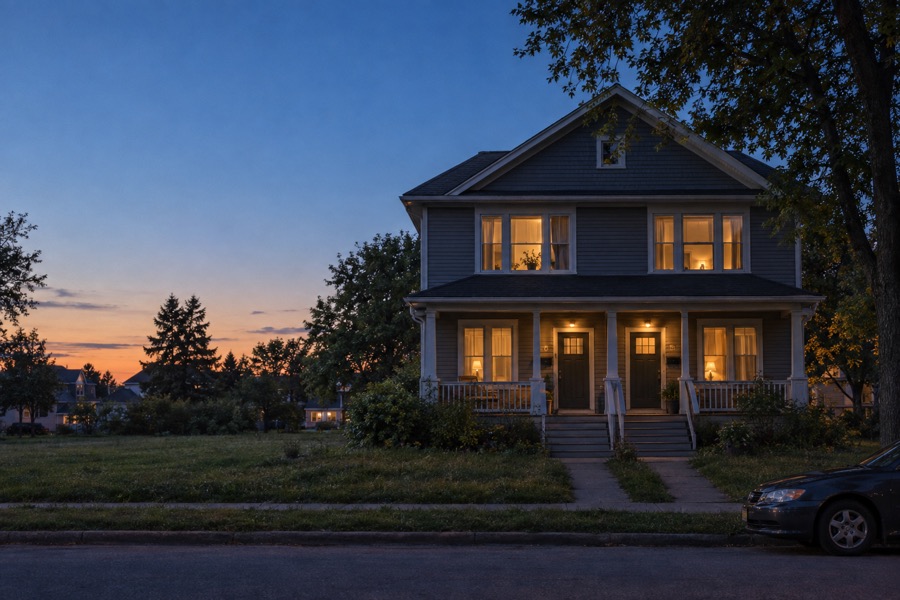
On the duplex:
Gross rent:          $3,800 × 12 = $45,600
Vacancy (5%):                      $2,280
Operating expenses:               $17,100
NOI:                              $26,220
Operating expenses are the costs of running the building: property taxes, insurance, management, repairs, and any utilities the owner pays. NOI leaves out the mortgage, depreciation, capital expenditures, and income taxes, because those depend on who owns the building and how they paid for it, not on the building.
What it can't see: the loan, and the roof. A building can post a healthy NOI and still need a large capital expense in a year NOI never reflects. And because every metric below is built on NOI, an overstated rent or an understated expense line flows into all of them. The NOI guide covers what belongs on each side of the line.
Cap Rate: The Income Against the Price
Cap Rate = NOI ÷ Purchase Price
$26,220 ÷ $425,000 = 6.2%
Cap rate turns NOI into a yield, so buildings of different sizes and prices can be compared on one axis. It is also how the market prices income. Run the formula backward, Value = NOI ÷ Cap Rate, and the same $26,220 is worth $524,400 at a 5% cap. A published cap rate from a survey like CBRE's or Marcus & Millichap's only means something against an unlevered number, which is why cap rate leaves the loan out on purpose.
What it can't see: the financing. Two buyers of the duplex compute the same 6.2% whether one pays cash and the other borrows 80%. A higher cap rate also isn't simply better. It usually means the market is pricing in more risk. The cap rate guide covers the ranges and what moves them, and What Is a Good Cap Rate? tracks the published benchmarks.
Cash-on-Cash Return: What the Owner's Cash Earns
Cash-on-Cash = (NOI − Annual Debt Service) ÷ Total Cash Invested
Finance the duplex with 20% down ($85,000) plus $12,000 of closing costs, and a $340,000 loan at 7% over 30 years. The payment is $2,262.03 a month, $27,144 a year.
Cash flow    = $26,220 − $27,144 = −$924
Cash-on-cash = −$924 ÷ $97,000   = −1.0%
The building yields 6.2%. The owner's $97,000 yields −1.0%, and the owner funds $924 a year to hold the property. The reason is that the loan costs $27,144 ÷ $340,000 = 7.98% of its balance each year, more than the building earns on its price. At 50% down the same duplex produces $9,255 of cash flow on $224,500, a 4.1% cash-on-cash. Less debt, higher return, because the debt was costing more than it earned.
What it can't see: principal paydown, appreciation, and taxes. Year one of the loan retires $3,454 of principal, which cash-on-cash counts as money gone. The cash-on-cash guide covers the denominator and the leverage math in detail.
How the Three Connect
| Metric | Formula | Duplex | Question it answers | Leaves out |
|---|---|---|---|---|
| NOI | Rent − vacancy − operating expenses | $26,220 | What does the building earn? | Loan, capex, taxes |
| Cap rate | NOI ÷ price | 6.2% | What does it yield on its price? | Loan, future years |
| Cash-on-cash | (NOI − debt service) ÷ cash invested | −1.0% | What does my cash earn this year? | Paydown, appreciation, taxes |
The chain runs in one direction. An error in NOI moves the cap rate, and it moves cash-on-cash even more, because the debt service stays fixed while the income changes. Cut the duplex's rent by 10% and the cap rate falls about one point, to 5.2%. Cash-on-cash falls about four and a half, to −5.4%.
The gap between cap rate and cash-on-cash is the loan. When it's large and negative, as on the duplex at 7%, the building is fine and the financing is the problem. Cap Rate vs Cash-on-Cash works through when each metric is the right one.
What the First Three Don't Cover
Three more questions come up on almost every deal, and each has its own metric.
Does the income cover the loan? That is DSCR, NOI ÷ annual debt service. On the duplex, $26,220 ÷ $27,144 = 0.97. See the DSCR formula guide.
What is the total return, including equity? That is ROI, which adds principal paydown and appreciation to cash flow. On the duplex, the first year without appreciation is (−$924 + $3,454) ÷ $97,000 = 2.6%. See Rental Property ROI.
What is the return over the whole hold? That is IRR, which puts timing on every cash flow including the sale. See IRR in Real Estate.
The Trap
Each of the three metrics is a single year, pre-tax, and only as good as the NOI underneath it. A listing will usually quote whichever one looks best. On the duplex that's the 6.2% cap rate, which is true of the building and says nothing about the −1.0% the financed buyer earns on the same property.
Keep reading
- 1031 Exchange Rules: Timelines, Like-Kind Property and What Gets DeferredHow a 1031 exchange defers capital gains on a property sale: the like-kind and equal-value rules, the 45 and 180 day deadlines, and where exchanges fail.
- Break-Even Occupancy: How Empty a Rental Can Get Before It Loses MoneyThe break-even occupancy and break-even rent formulas for a rental property, worked with real numbers, and what the result says about risk and financing.
- The BRRRR Method: Buy, Rehab, Rent, Refinance, Repeat, With the MathHow the BRRRR method works step by step, how much cash the refinance actually returns, and where the numbers break when the appraisal comes in low.